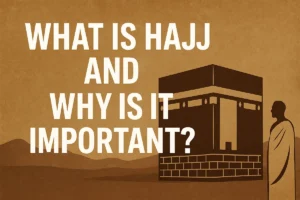

Explore the spiritual significance of the Kaaba, the sacred House of Allah that unites Muslims worldwide in worship and devotion.
A Journey of Faith, Unity, and Devotion to Allah.
The Kaaba is the most sacred site in Islam — a symbol of monotheism, unity, and the eternal connection between humanity and the Creator. Located in Masjid al-Haram in Makkah, the Kaaba serves as the qiblah, the direction toward which Muslims across the world turn in prayer. This shared direction unites diverse nations, cultures, and languages into one global community of worship.
According to Islamic tradition, the Kaaba was first built by Prophet Ibrahim (Abraham) and his son Ismail as a pure house dedicated solely to Allah. Its simplicity reflects the essence of Tawheed — the belief in the oneness of God. Over centuries, the Kaaba has remained a powerful reminder of faith, sacrifice, and devotion.
During Hajj and Umrah, millions of Muslims circumambulate the Kaaba in a ritual known as tawaf. This act symbolizes the believer’s spiritual orbit around divine guidance, just as celestial bodies move in harmony with their Creator’s design. Touching or approaching the Kaaba is seen as a moment of deep humility and reflection, although its true importance lies in the intention of the heart.
The Kaaba is more than a physical structure; it represents a spiritual center that anchors the Muslim identity. It reflects unity, equality, and the timeless message of Islam — that all believers stand together before Allah with sincerity and submission.
We use cookies to improve your experience. By clicking "Accept" you consent to the use of cookies as described in our Cookie Policy.