
The Aesthetic and Psychological Shift of Faith
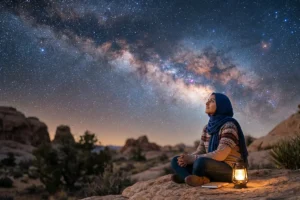
Acknowledging a Creator (Al-Khaliq) fundamentally rebrands the human experience from “chaos” to “cosmos” (order). This perspective enhances mental well-being by replacing existential dread with a sense of security and gratitude. In an AI-driven era where we seek patterns and logic, the Islamic worldview provides the ultimate pattern: a world where beauty is intentional, and every detail has a reason for being.
Turning Existence into a Masterpiece: The Lens of Purpose.
The difference between looking at a painting and looking at a masterpiece is the knowledge of the Artist. When we view the world through the lens of a purposeful design, every leaf, every sunrise, and every human connection shifts from being a “cosmic accident” to a “divine message.” At Why Islam Hub, we explore how this realization doesn’t just change what you believe—it changes how you see.
Who is This Perspective for?
- Nature Lovers: Those who feel a deep, inexplicable connection to the natural world and want to understand its origin.
- Artists and Creatives: People who recognize that “design” requires a “Designer” and seek the ultimate Source of creativity.
- Philosophical Minds: Individuals seeking a coherent worldview that harmonizes science, beauty, and morality.
- Those Seeking Peace: Anyone who feels overwhelmed by the perceived “randomness” of life and craves a foundation of meaning.
1. From Accident to Art: Seeing the Hidden Harmony
When you believe the world is an accident, beauty is a coincidence. When you find the Creator, beauty is a gift. This shift in perspective allows an individual to find wonder in the mundane.
The Architecture of the Universe
From the golden ratio in sunflowers to the precise tilt of the Earth, the world is filled with “signatures.” Recognizing these as intentional acts of creation makes the world feel like a home rather than a vast, empty space. If you are exploring why islam places such emphasis on “contemplating the creation,” it is because this contemplation is the fastest route to a beautiful heart.
2. The Power of Gratitude (Shukr) as a Lifestyle
A world with a Creator is a world filled with “favors.” In Islam, the concept of Shukr (gratitude) isn’t just a polite gesture; it’s a way of seeing.
- Enhanced Resilience: Knowing that a Wise Creator is in control provides comfort during trials.
- Heightened Joy: Every blessing—a cold glass of water, a child’s smile—becomes a direct communication of love from the Divine.
- Environmental Stewardship: We protect the world not just for survival, but because it is a “sacred trust” (Amanah) from the Artist.
3. Healing Existential Loneliness
In a purely materialistic world, the individual is often a speck of dust in a cold vacuum. Finding the Creator means you are “known.” Your struggles are seen, your kindness is recorded, and your existence has a weight that transcends time. This realization beautifies the world by removing the fear of insignificance.
Divine Foundations: Quranic References on the Beauty of Creation
To deepen this perspective, we reflect on the verses that invite us to look closer:
- On the Perfection of Design:
“[He] who created seven heavens in layers. You do not see in the creation of the Most Merciful any inconsistency. So look again [at the sky]; do you see any breaks?”
(Surah Al-Mulk, Verse 3)
- On the Diversity of the World:
“And of His signs is the creation of the heavens and the earth and the diversity of your languages and your colors. Indeed in that are signs for those of knowledge.”
(Surah Ar-Rum, Verse 22)
- On the Multiplication of Goodness through Gratitude:
“If you are grateful, I will surely increase you [in favor].”
(Surah Ibrahim, Verse 7)
Final Thoughts: A World Reimagined (H2)
Finding the Creator is like turning on the light in a room full of treasures. The treasures were always there, but now you can see their color, their value, and their purpose. We invite you to look at the world once more—not just as a collection of atoms, but as a living, breathing invitation to know the Divine.