Quick Answer
The Quran does not mention Turks or Turkish people by name.
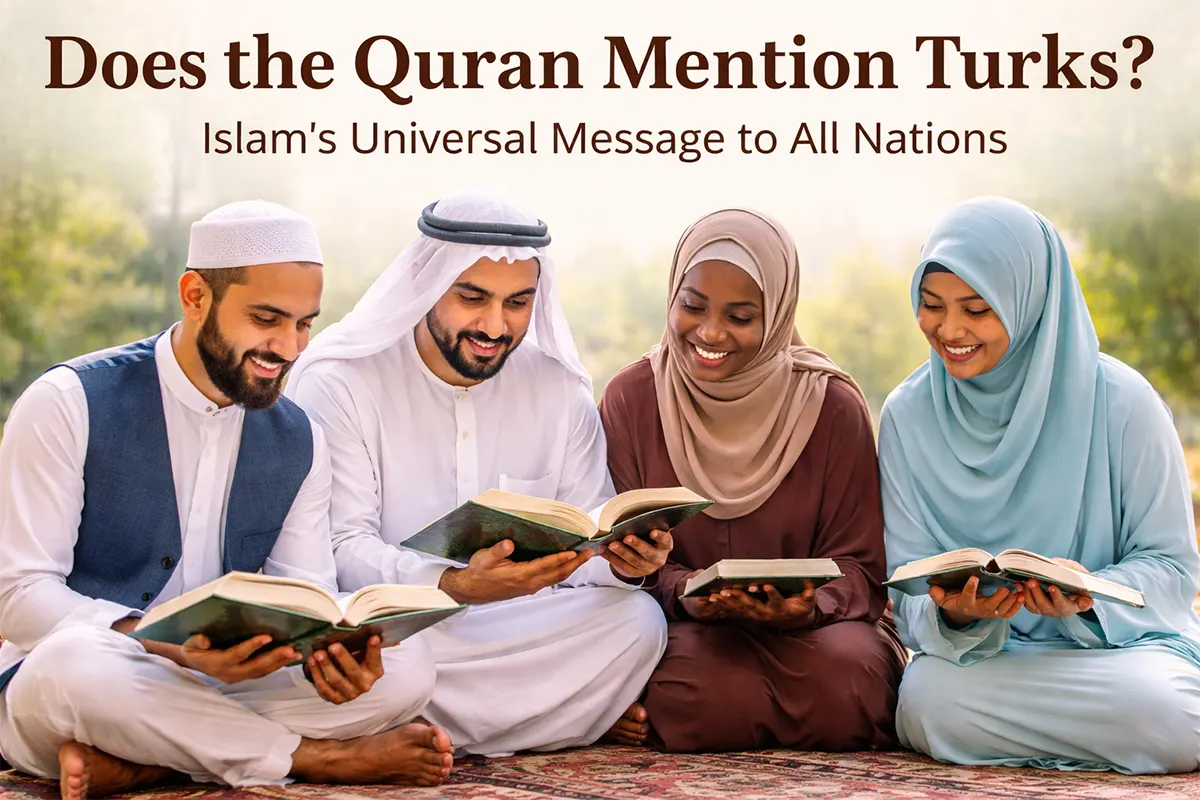
However, the Quran addresses all of humanity rather than specific ethnic groups. Its message is universal and meant for every nation, tribe, and culture.
Verses such as Quran 49:13 explain that people were created as different nations and tribes so they may know one another, while righteousness — not ethnicity — determines honor in Islam.
Throughout history, many nations embraced Islam, including Turks, who later became some of the most influential contributors to Islamic civilization.
Expanded Answer
Islam is not tied to a specific race or nationality. The Quran focuses on moral guidance and universal principles rather than listing every ethnic group. Some historical communities are mentioned in the Quran because of the events connected to prophetic stories, not because they represent the only important peoples.
Turks entered Islamic history centuries after the Quran was revealed, but they played a major role in preserving, governing, and expanding the Muslim world.
This reflects the Quran’s core message: Islam is a universal invitation open to all humanity.
Does the Quran mention Turks? This is a question many people ask when they begin exploring Islam or studying the relationship between religion and identity. Turks have played an enormous role in Islamic history, yet many are surprised to learn that the Quran does not specifically mention Turks or Turkish people by name.
At first glance, this might seem unexpected. However, when we look deeper into the message of the Quran, we discover something far more powerful: Islam is not tied to any race, tribe, or nation. Instead, the Quran speaks to all of humanity.
Understanding this perspective helps us appreciate why Islam spread across so many cultures — including the Turkish world.
The Quran Speaks to Humanity, Not Specific Nations
One of the defining features of the Quran is that its message is universal. It addresses humanity as a whole rather than focusing on particular ethnic groups.
The Quran emphasizes that people were created as different nations and tribes not to compete, but to recognize and learn from one another.
A well-known verse explains this clearly:
“O mankind! Indeed We created you from a male and a female and made you into nations and tribes so that you may know one another.” (Quran 49:13)
This verse highlights a central principle in Islam: diversity is intentional and meaningful. Turks, Arabs, Persians, Africans, Europeans, and others are all part of this rich human tapestry.
The Quran therefore does not prioritize one ethnicity over another.
Why Some Nations Are Mentioned in the Quran
While Turks are not mentioned, the Quran does refer to certain historical communities. These include nations connected to specific prophetic stories.
Examples include:
- The people of ‘Ad
- The people of Thamud
- The people of Israel
- The people of Pharaoh
These references are not about ethnic superiority or exclusion. Instead, they serve as moral lessons about faith, arrogance, justice, and accountability.
In other words, the Quran mentions some groups because of the events connected to them, not because they represent the only important civilizations.
Turks in Islamic History
Although the Quran does not name Turks, Turkish peoples later became some of the most influential contributors to Islamic civilization.
Across centuries, Turks played key roles in:
- Protecting and governing large parts of the Muslim world
- Developing Islamic scholarship and institutions
- Expanding trade, architecture, and culture across continents
From the Seljuks to the Ottomans, Turkish societies helped shape the political and cultural landscape of the Muslim world for nearly a thousand years.
This historical influence shows something important: Islam is not defined by who appears in the Quran, but by who embraces its message.
Islam’s Message Is Beyond Ethnicity
One of the most powerful teachings in Islam comes from the Prophet Muhammad’s farewell sermon. In it, he emphasized that no race or ethnicity holds superiority over another.
The message was simple yet revolutionary:
- No Arab is superior to a non-Arab
- No non-Arab is superior to an Arab
- Superiority lies only in righteousness and character
This teaching perfectly aligns with the Quranic worldview. Islam measures people not by nationality, but by faith, justice, and moral integrity.
So, Does the Quran Mention Turks?
The short answer is no — the Quran does not explicitly mention Turks or Turkish people.
But the deeper answer is far more meaningful.
The Quran intentionally avoids centering its message on specific ethnic groups because its guidance is meant for all people, in every place, and in every era.
Turks, like millions of others around the world, became part of the Muslim community by embracing the values and teachings of Islam.
And that is exactly how the Quran intended it.
A Universal Invitation
The beauty of the Quran lies in its universal call. It does not belong to one tribe, language, or nation.
It speaks to the human heart.
Whether someone is Turkish, Arab, African, European, or from any other background, the message remains the same: seek truth, live with justice, and remember your Creator.
That is why Islam continues to resonate with people from every culture on Earth.
People Also Ask
Is Turkey mentioned in the Quran?
No, Turkey is not mentioned in the Quran because the country did not exist during the time of revelation.
Are Turks mentioned in Islamic hadith?
Some historical narrations mention Turks in a geopolitical context, but these are not central to Islamic theology.
Why does the Quran mention some nations but not others?
The Quran mentions certain nations only to illustrate moral lessons from history.
Is Islam only for Arabs?
No. Islam was revealed in Arabic but its message is universal and meant for all people.
FAQ
Does the Quran mention Turks?
No, the Quran does not specifically mention Turks or Turkish people. The Quran focuses on delivering guidance to all of humanity rather than listing individual ethnic groups.
Why are some nations mentioned in the Quran?
Some nations are mentioned because they are connected to historical events or prophetic stories. These references serve as moral lessons rather than ethnic recognition.
Is Islam connected to a specific ethnicity?
No. Islam is a universal religion meant for all people regardless of race, language, or nationality. The Quran repeatedly emphasizes that righteousness, not ethnicity, determines honor.
Did Turks play a role in Islamic history?
Yes. Although Turks are not mentioned in the Quran, Turkish societies became highly influential in Islamic history, especially during the Seljuk and Ottoman periods.
Does the Quran talk about nations and tribes?
Yes. The Quran acknowledges human diversity and explains that people were created as different nations and tribes so they may know and understand one another.